

Growing a dental practice sounds simple until you’re in it. Patients are coming in, staff are showing up, the schedule is filling, and somehow something still feels off. Revenue eventually plateaus and hiring decisions often backfire, leaving the owner stretched across work that should really belong to three different people.
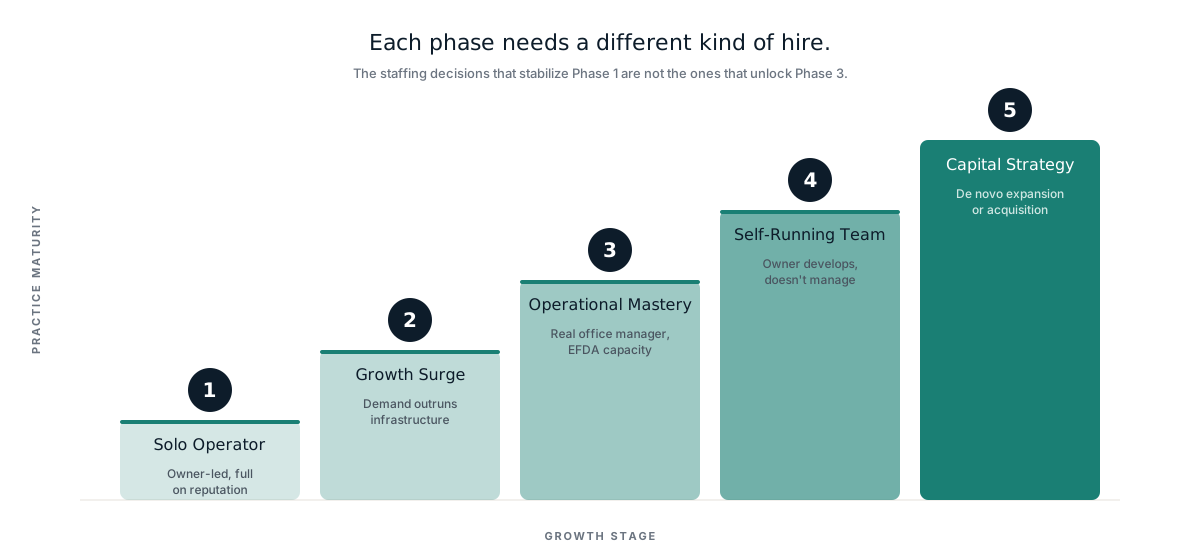
Practice owners often assume it’s a hiring problem, but it usually isn’t. There are five distinct phases most practices move through on the way to real scale, and each one has its own set of pressures, its own hiring blind spots, and its own version of the owner it needs to function well.
Understanding where you are changes everything about what you do next. Here’s a look at each phase, what makes it hard, and who you actually need on your team to move through it.
Phase 1: The solo operator trap
Most practices start here, and a surprising number stay longer than they should.
The owner is excellent clinically. Patients love them and the schedule fills on reputation alone. That’s something to be proud of. But when every operational decision, from scheduling and hiring to billing disputes and vendor calls, still runs through one person, the whole practice is essentially running on that person’s energy. And that energy, no matter how good the owner is, has a ceiling.
This phase feels manageable because it is manageable. That’s what makes it so easy to stay in. A practice can sit here for years, pulling decent revenue, never quite putting down the foundation that real growth needs. The owner mistakes being busy for being on track, and it’s an easy mistake to make when things seem fine on the surface.
The shift happens when the owner decides to build a business rather than carry one. That means being selective about who comes on first, because these early hires set the tone for how the whole practice operates. A front desk person who fully owns the schedule and insurance verification. A dental assistant who works confidently without needing sign-off on every task. It’s still a small team, but it functions like a real one.
Getting this phase right doesn’t require a large team or a perfect plan, just a few people with real ownership over their roles. That’s enough to open the door to what comes next.
Phase 2: The growth surge and the valley that follows
Something clicks. Word of mouth picks up, new patient flow increases, and revenue starts climbing in a way that feels different from before. For many owners, this is the first time the practice feels like it’s truly taking off, and that energy is worth celebrating.
It’s also where some of the most damaging decisions get made.
Growth at this stage tends to outrun infrastructure. The schedule fills faster than hiring can keep up, and a hygiene chair suddenly sits empty because recruitment never started early enough.
According to ADA Health Policy Institute data from Q4 2025, 31.4% of dentists were actively recruiting dental hygienists in the prior three months, with a similar share recruiting dental assistants. In today’s tight market, waiting until the chair is empty to start looking is already too late.
That “valley” is very real. Expanding hours, operatories, and marketing without the operational systems and team to support it creates intense pressure. Key team members burn out, patient experience slips, and the owner who thought they were finally stepping back ends up more trapped than ever.
Getting through Phase 2 successfully means resisting the urge to scale everything at once. The practices that emerge stronger make deliberate, proactive hires that build real capacity before the pressure peaks.
Phase 3: Operational mastery
Revenue is stable and the patient base is strong. The practice has also, quietly, stopped growing.
This is one of the most common places practices get stuck, and the frustrating part is that nothing feels visibly wrong. Things are running. Patients are happy. But the kind of growth that requires different infrastructure simply won’t come without it, and Phase 3 is where that infrastructure has to get built.
What that looks like in practice:
- A real office manager who fully owns AR, insurance, team communication, and scheduling. Someone who can make decisions and solve problems without the owner in the room. That role, filled well, frees up an enormous amount of the owner’s time and headspace.
- The right person in that seat, not just the most loyal or longest-tenured. Placing a great hygienist or receptionist into an operations role they’re not suited for doesn’t do them any favors. It’s worth hiring for this one deliberately.
- An expanded-functions dental assistant. In Arizona, EFDAs can place restorations, take final impressions, and perform coronal polishing. For a practice trying to maximize provider output without bringing on a full associate, that’s a strong option.
Paying for real operational talent, even when the instinct is to promote from within or keep costs low, is what actually moves a practice out of this phase.
Phase 4: Building a team that runs without you
An associate is coming on, hours are expanding, and maybe a second location is on the table. The practice can’t be managed like a solo operation anymore, and the owner’s job shifts from managing people to developing them.
That shift is hard for owners who built everything themselves and have high standards for how it should run. But it’s the whole game at this phase.
What Phase 4 actually requires:
- A leadership mindset from the owner. The goal is a team that can operate, make decisions, and maintain patient experience without constant oversight.
- Retention that goes beyond compensation. DSOs like Aspen, Heartland, and Pacific Dental are actively recruiting in Arizona with sign-on bonuses, tuition reimbursement, and benefits packages most independent owners can’t match. The counter to that is culture: strong team members at independent practices have real visibility and real impact, and that’s a pitch worth making clearly and often.
- Leadership infrastructure before clinical expansion. Adding an associate without a strong office manager already in place, or extending hours before the team can hold the standard, creates problems that take a long time to unwind.
Expanding clinical capacity is exciting. Making sure the team is ready to carry it is what makes the expansion stick.
Phase 5: Capital strategy and model duplication
The practice is profitable, the systems work, and the team runs well. Now the question is whether and how to scale further.
Phase 5 is where decisions become primarily financial. De novo expansion or acquisition? What does growth require in capital, and what’s the realistic return timeline? These are business questions, and many owners arrive here without having fully built the toolkit to answer them.
What to get right before scaling:
- Duplicate a model that’s actually ready. A second location inherits whatever inefficiencies exist in the first one, at twice the overhead. Front desk turnover, hygienist shortages, credentialing issues. Every staffing vulnerability shows up amplified in the expansion.
- Operational leadership that’s solid. Clean hiring processes, strong retention, and a staffing approach that reduces risk at every hire aren’t things to build in parallel with expansion. They need to already be working.
- Honest self-assessment. Asking hard questions about readiness before signing a lease on location two is what separates a smooth expansion from an expensive one.
Getting to Phase 5 is a real achievement. Taking the time to make sure the foundation is solid before adding to it is what makes the next phase worth the investment.
How to hire ahead of the stage you’re in
The single most common staffing mistake across dental practices: hiring to solve a current problem rather than positioning for the next phase.
Before the next hire, three questions worth sitting with:
- What does the schedule look like in 90 days if this role stays unfilled?
- Does this hire solve a short-term vacancy, or does it build capacity for where the practice is heading?
- Is there enough real information about this candidate to hand them a patient and feel confident?
That third question is the one that gets skipped most often, especially under pressure. Contract-to-hire is a model most dental practices in Arizona have rarely been offered, and even fewer have used effectively. A defined working period before a permanent commitment gives both sides a real evaluation window. The right person gets confirmed. The wrong fit gets identified before it costs the practice months of disruption and a placement fee with no meaningful recourse.
Each phase of practice growth has its own staffing logic. The hire that stabilizes Phase 1 is different from the one that unlocks Phase 3. Knowing which phase the practice is in and hiring for the one ahead is what separates steady growth from years of spinning in place.
Which phase does your practice feel like it’s in right now?